
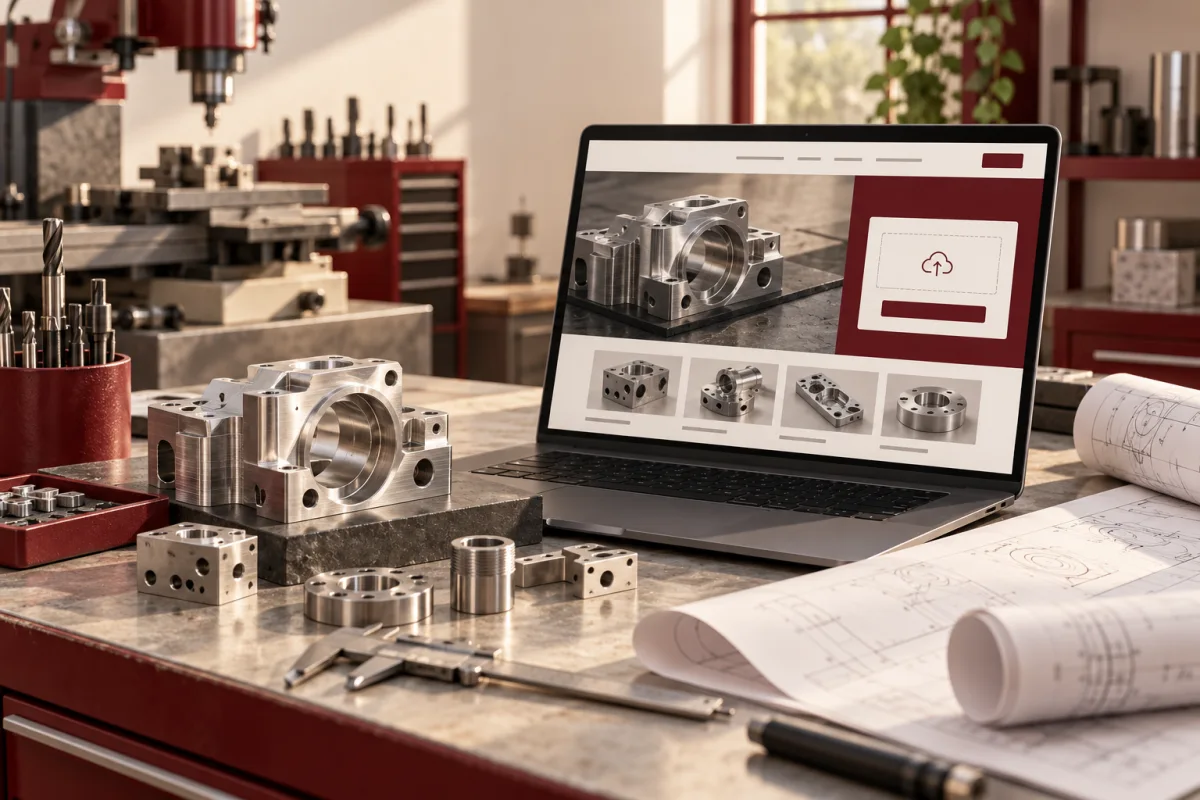
An engineer has a drawing and a deadline. They open your manufacturing website to decide whether your shop belongs on the shortlist. A dramatic photograph of sparks does not tell them whether you can handle the material, tolerance or production volume.
Manufacturing website design should help a technical buyer assess fit and send an RFQ your estimating team can use. The commercial objective is relevant opportunities, not an inbox filled with incomplete drawing uploads.
Explain processes, materials, applicable capacity and supported quality claims accurately. Guide the buyer through RFQ requirements and protect confidential documents. A better site can remove friction; it does not guarantee RFQ volume or contract awards.
Organise the site around the buying decision
Separate meaningful capabilities such as machining, fabrication, finishing or assembly where actually offered. Use the terminology buyers and estimators recognise. State limits carefully rather than implying the shop can manufacture anything.
Describe materials, part types, production context and relevant equipment only to the extent the business can substantiate. Have technical staff review the copy. Avoid broad tolerance claims that may depend on material, geometry or process.
Make quality claims verifiable
Publish accurate certifications and their applicable scope, with current documents or verification where appropriate. Do not add certification badges or customer logos merely because they look reassuring.
Case examples can explain the problem, process and deliverable without inventing a performance improvement. Use approved project photographs and descriptions. A shop may need to protect the customer’s geometry, identity or commercial details.
Give RFQs a useful structure
| RFQ detail | Why estimating needs it | Website treatment |
|---|---|---|
| Process or part description | Initial capability fit | Plain options plus clarification |
| Material and quantity | Commercial and production context | Allow an estimate or “to confirm” where appropriate |
| Drawing and revision | Identify what is being quoted | Approved secure upload route |
| Required timing | Capacity discussion | Requested date, not an automatic promise |
| Contact and company | Clarify requirements | Relevant, proportionate intake |
Do not make every technical detail mandatory for an initial conversation. A buyer may need an NDA or capability discussion before sharing files. Offer a route that reflects that situation.
Handle drawings as controlled information
Keep submitted files out of the public media library. Define accepted formats, validation, access and retention. Avoid emailing unrestricted download links to broad distribution lists.
If work carries special contractual, export or information-security requirements, identify the approved process before inviting uploads. A standard marketing form should not imply it is authorised to receive every category of drawing.
Use real shop photography with permission
Show the actual environment, relevant equipment and approved sample work. Plan photographs so screens, documents and customer parts do not expose restricted information. A caption explaining the process often gives a technical buyer more value than a decorative image.
When stock photography is used, label it as illustrative and avoid suggesting the pictured machine is installed in your shop. Conceptual covers can introduce an article; they should not stand in for evidence of capability.
Connect the RFQ to estimating
Create a reference, assign an owner and record missing information. Track the drawing revision being quoted and retain the submitted scope. If the customer sends a revised drawing later, make the change visible.
The companion guide to fabrication job tracking software follows that information into production. A CRM workflow may own the opportunity while a job system owns the released work.
Measure qualified RFQs and response readiness
Review fit with actual capabilities, completeness, time spent clarifying requests and estimates issued. A lower volume of better-matched RFQs may be more useful than a large increase in unsuitable submissions.
Publish useful capability explanations and answers to questions your estimators repeatedly receive. Avoid making technical content longer simply to repeat a keyword.
Should every equipment specification be public?
No. Publish what helps buyers assess fit and what the business is comfortable substantiating. Sensitive or context-dependent details may belong in a conversation.
Can an RFQ form automatically promise a delivery date?
Only if an approved process can make that commitment. Otherwise capture the requested date and explain the review step.
Tell us your capabilities, RFQ requirements and confidentiality process. Deepak Softech can discuss a manufacturing website built around that technical buying journey.
Plan my manufacturing website ↗Editorial note: published 21 October 2026. Budget and time-saving examples are explicitly illustrative. Vendor capabilities and terms can change; check linked primary sources and written proposals for your requirements.
 Chat with us