
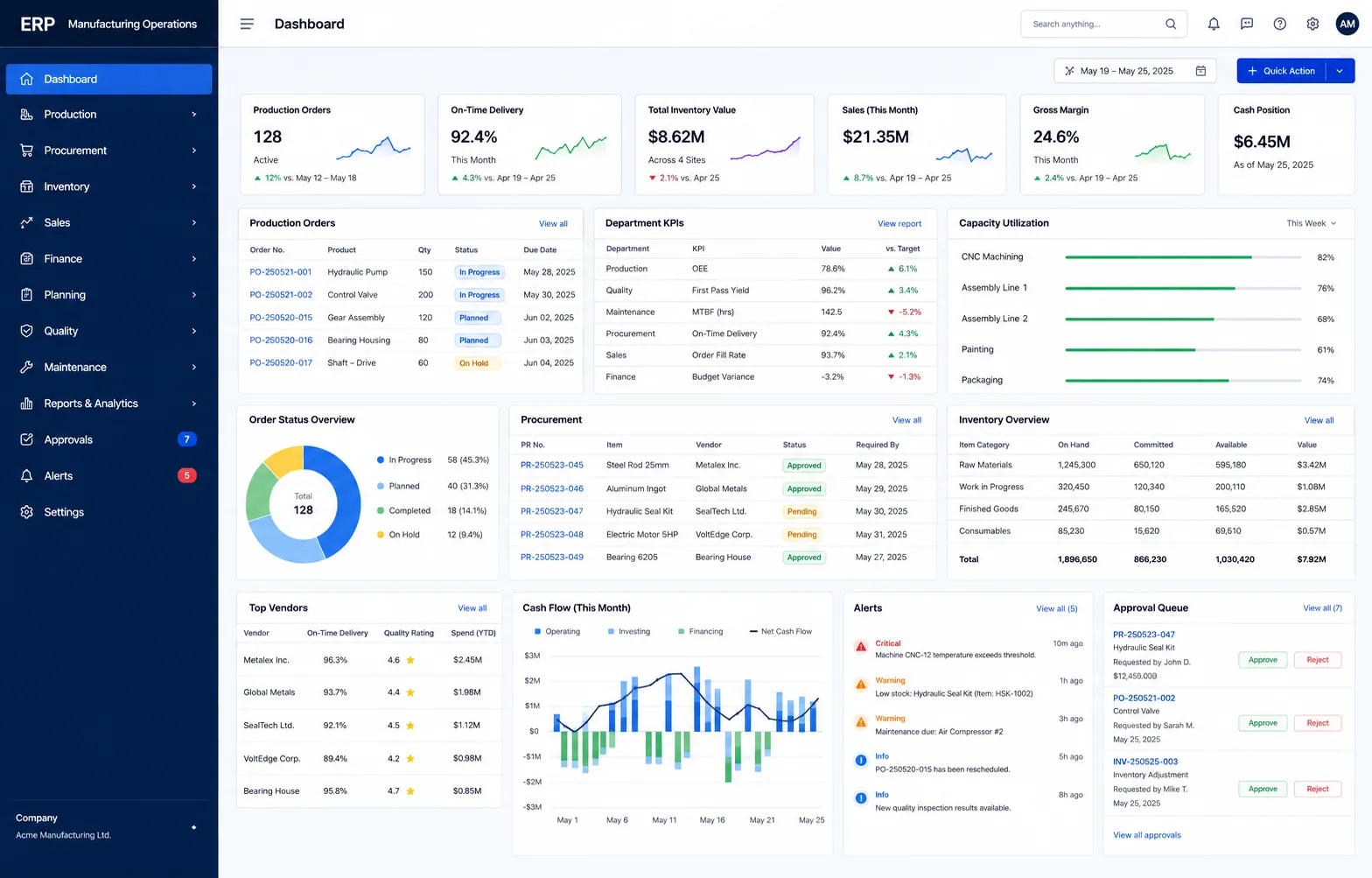
Quick answer: ERP succeeds when it creates one dependable operational record, not when it merely reproduces every spreadsheet.
Define the operational backbone
Identify master records such as customers, suppliers, products, locations and accounts. Then map transactions: enquiries, quotations, orders, purchases, receipts, production, dispatch and payment. The ERP data model should connect these events without duplicate entry.
Prioritize modules by dependency
Inventory accuracy may depend on purchasing and goods receipt; production planning may depend on bills of materials and available stock. Build in an order that creates reliable upstream data. Trying to launch every module simultaneously increases migration and adoption risk.
Evaluate the development company
Look for workflow discovery, role-based permissions, audit history, reporting design, API capability, testing discipline and migration experience. Ask the company to explain exception handling—returns, partial deliveries, cancellations and corrections often reveal whether the design is operationally realistic.
Plan integrations and reporting
List accounting, ecommerce, payment, WhatsApp, barcode, GPS or machine integrations early. Define management decisions each dashboard must support. Reports should use agreed business definitions rather than calculations recreated differently by each department.
Measure ERP value
Track inventory accuracy, order cycle time, approval time, manual entries, production delays and reporting effort before and after rollout. These measures keep the project connected to business outcomes.
Discuss your requirement
Deepak Softech LLP designs business websites and custom software around measurable workflows. Share the process you want to improve and we will help identify a practical first release.
 Chat with us