
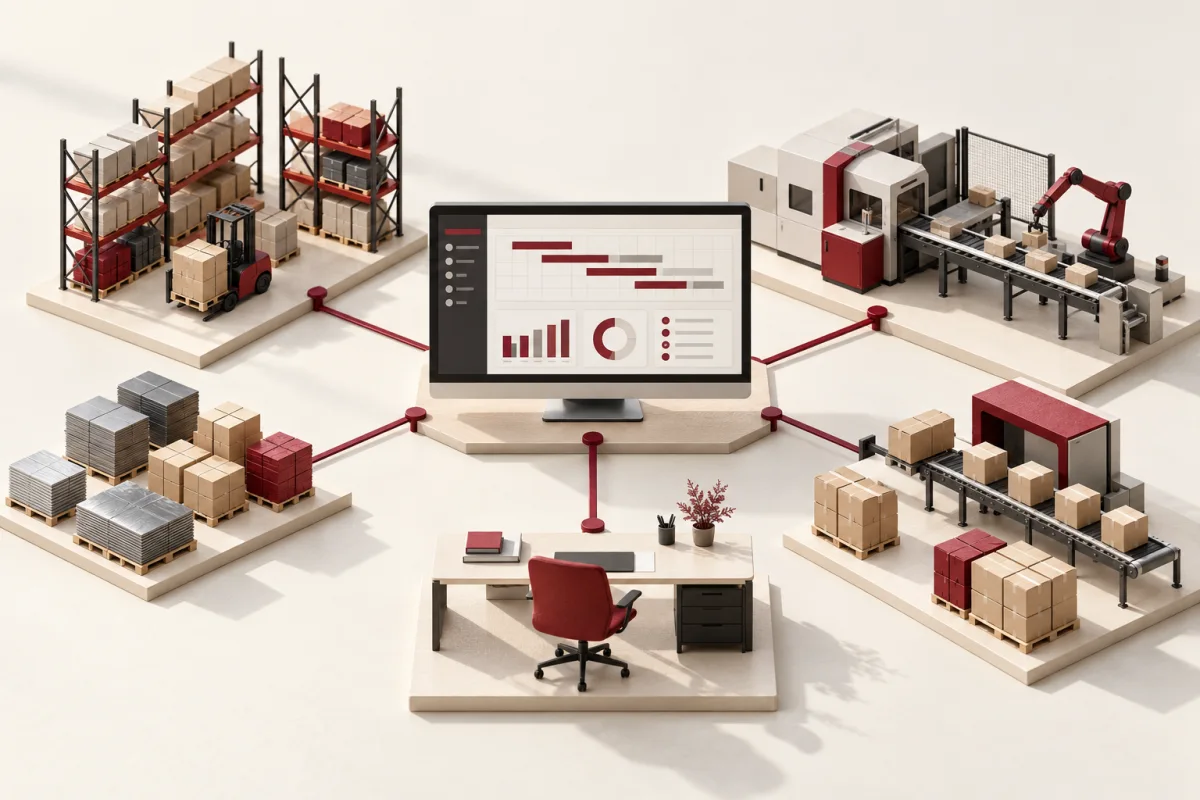
Sales promises Friday. Purchasing says the material is on order. The workshop has a different priority list. Finance discovers the job’s margin after the order has shipped. Everyone may be working hard while the information moves too slowly.
Custom ERP software development can connect those decisions, but a large platform is not the starting point. First identify which production or inventory decision becomes unreliable because records are late, duplicated or disconnected.
Start with dependable items, stock movements, bills of materials, production orders and clear ownership of each step. Add planning and costing around accurate records. Consider an established manufacturing ERP before building custom; commission distinctive workflows where they create a clear operational advantage.
Map one order from enquiry to dispatch
Use a real but anonymised order. List the quotation, promised date, material requirement, purchasing decision, production stages, quality checks, dispatch and invoicing. Record where people wait, re-enter data or make decisions using information they do not trust.
A make-to-order workshop may need revision-controlled drawings and job costing. A batch producer may depend on lot traceability, expiry dates and recipe versions. A distributor with light assembly may mainly need purchasing, inventory and order visibility. They should not share an identical ERP brief.
Ask a supervisor to explain what happens when the plan changes halfway through a job. Exceptions reveal the requirements that a tidy flowchart tends to miss.
The modules that deserve a place on the shortlist
| Capability | Business question it should answer | Data it needs |
|---|---|---|
| Inventory and purchasing | What can we promise without guessing? | Items, units, locations, reservations and supplier lead times |
| Bills of materials | What does this version of the product require? | Components, quantities, revisions and substitutes |
| Production orders | What is happening now, and what is blocked? | Job stages, work centres, status and responsible people |
| Quality and traceability | Which checks and batches relate to this delivery? | Inspection records, lots, serials and release decisions |
| Job costing | Where did the planned margin change? | Material use, labour, scrap, subcontracting and agreed overhead rules |
Not every factory needs every module immediately. A dependable stock ledger and production status can be a better first release than a sophisticated schedule fed by inaccurate inventory.
Standard ERP, custom ERP or a connected layer?
Evaluate established systems using your own sample jobs. Microsoft Dynamics 365 Business Central, for example, presents ERP capabilities across finance and operations. Product suitability depends on the edition, implementation and your manufacturing requirements; confirm the detail in a demonstration.
Custom work is more defensible when the distinctive part of the operation cannot be handled sensibly through configuration. Sometimes the answer is a production or inspection layer connected to existing finance software, with a clear boundary between the systems.
Deepak Softech’s ERP development service and manufacturing software approach can be discussed in that context. The aim should be coherent operations, not a claim that every manufacturer needs a bespoke ERP.
What could a manufacturing ERP project cost?
Use scope scenarios rather than a universal price per module. The following USD allowances are editorial planning examples, not market averages, supplier packages or quotations.
- Focused operations layer: $20,000–$45,000. A limited workflow such as inventory visibility and production status, with defined boundaries.
- Connected manufacturing system: $45,000–$120,000. More extensive purchasing, bills of materials, production, quality and reporting work.
- Multi-site or complex ERP: $120,000+. Wider integrations, migration, site differences, resilience and access requirements can materially increase scope.
Allow separately for data cleanup, devices, barcode equipment, integrations, training, hosting and maintenance unless included. US procurement or hosting requirements may affect delivery choices. Any estimate should explain its assumptions and exclusions.
The implementation work nobody should skip
Standardise item codes and units before loading records. Agree how stock adjustments are authorised and why they occur. Assign responsibility for bill-of-material revisions and changes to production priorities.
Pilot one product family, line or location. Reconcile the new stock movements against physical checks. Test returns, scrap, partial completion, substitutions and cancelled orders. A smooth demonstration of the happy path is not enough.
Plan a controlled cutover with opening balances, ownership of unresolved transactions and a rollback procedure. Avoid an indefinite period where staff must keep two complete operating systems current; that doubles work and creates disagreements about which record is authoritative.
Measure benefits with a baseline
Pick a few measures the factory can collect reliably: inventory adjustment frequency, material shortages, time spent preparing a production report, schedule changes and the delay between a job finishing and its costs becoming visible.
Do not promise an improvement percentage before the baseline exists. Separate system issues from supplier performance, demand changes and capacity constraints. Better information makes decisions easier; it does not create production capacity by itself.
Frequently asked questions
Should we replace accounting at the same time?
Only if that is part of a clear business case. Keeping a reliable finance system and integrating approved transactions may reduce migration and training risk.
Is AI production scheduling the first priority?
Usually establish accurate inventory, lead times and job status first. Test any scheduling recommendation against actual constraints and keep a supervisor able to review and override it.
Describe the products, locations and handoffs involved. We can discuss a phased manufacturing workflow and which records need to become reliable first.
Discuss my manufacturing workflow ↗Editorial note: published 21 October 2026. Budget and time-saving examples are explicitly illustrative. Vendor capabilities and terms can change; check linked primary sources and written proposals for your requirements.
 Chat with us