
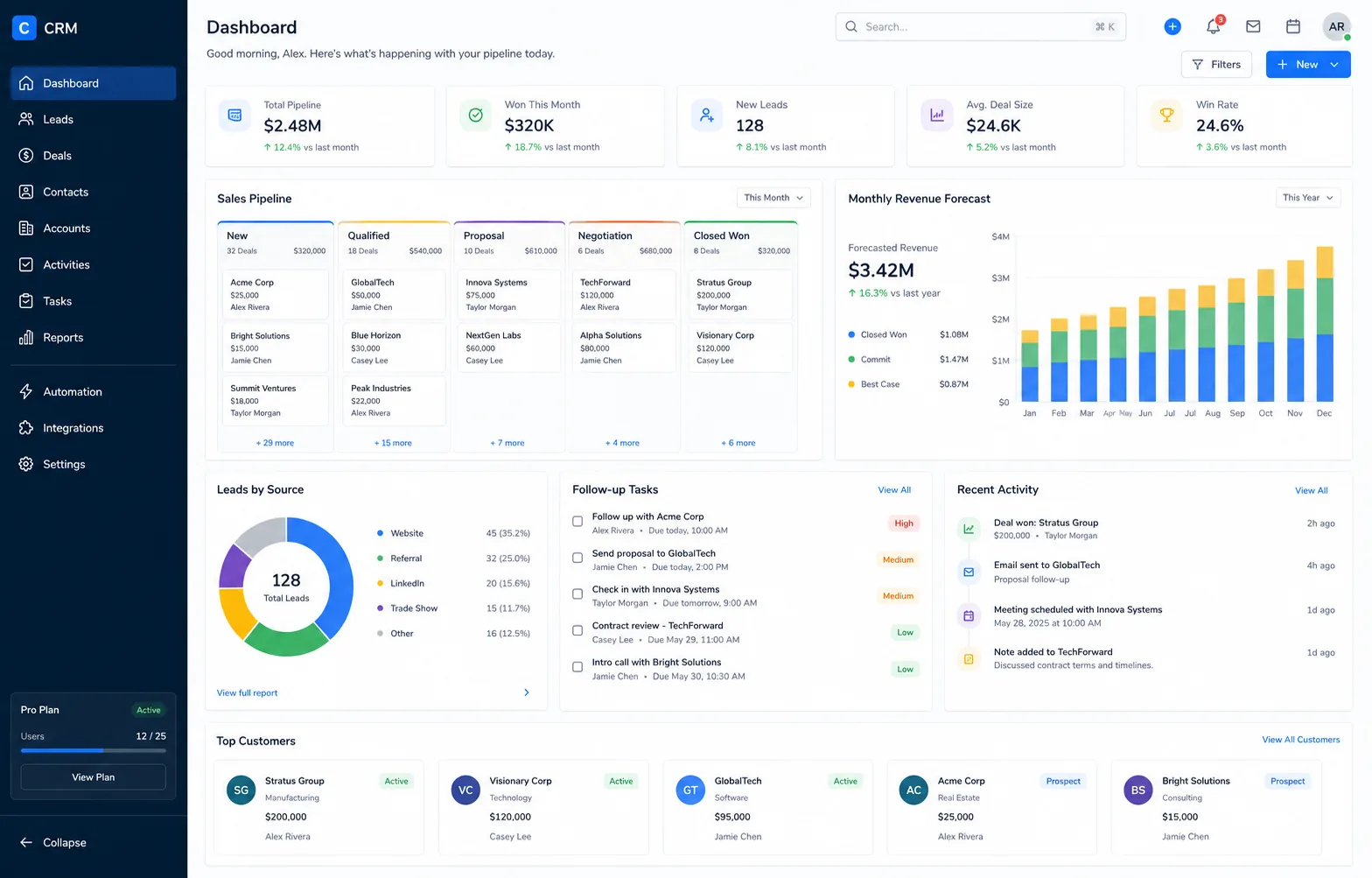
Quick answer: The best CRM makes the next action obvious, captures useful history automatically and gives managers reliable visibility.
Map the real sales process
Document lead sources, qualification, ownership, stages, follow-up rules, proposals, losses and handoffs. Include exceptions such as reassignment and inactive leads. A CRM should reflect these decisions while removing unnecessary variation.
Build for adoption
Minimize required fields, use sensible defaults and keep screens role-specific. Salespeople adopt a CRM when it reduces work through reminders, templates, call or WhatsApp history and automatic reporting. A complicated form that exists only for management will be bypassed.
What to assess in a CRM partner
Ask about permissions, activity history, duplicate handling, imports, API integrations, mobile usability, email delivery, backups and reporting. Review how the team tests automation so a reminder or assignment rule cannot silently create incorrect actions at scale.
Start with a focused release
Lead capture, assignment, pipeline, next action and a management dashboard are often enough for version one. Add quotations, support, renewals or marketing automation after core data is trusted.
Measure the result
Track response time, follow-up completion, pipeline aging, conversion rate and forecast accuracy. These indicators show whether the CRM is improving behavior rather than simply storing records.
Discuss your requirement
Deepak Softech LLP designs business websites and custom software around measurable workflows. Share the process you want to improve and we will help identify a practical first release.
 Chat with us